Overview
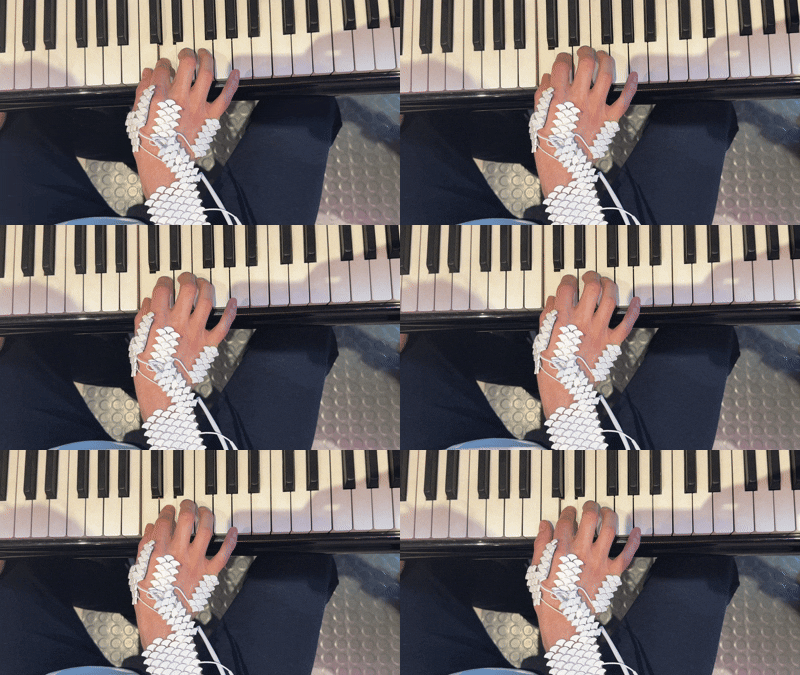
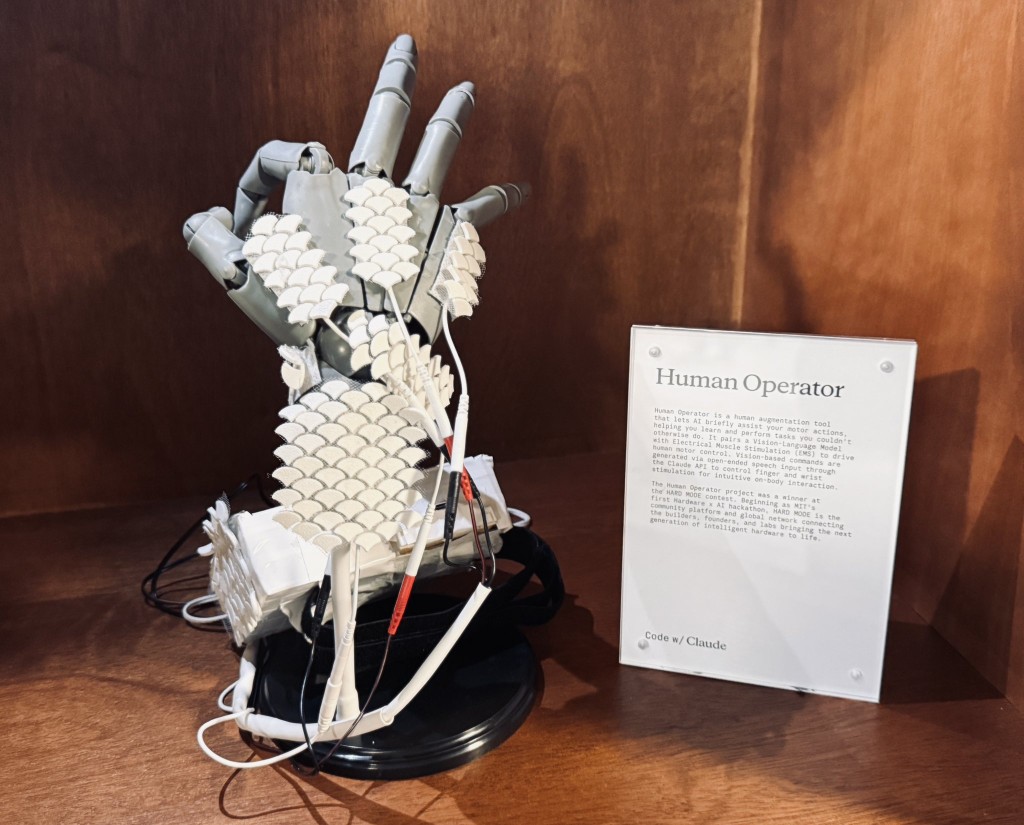
Human Operator is a wearable augmentation system that actively moves your body based off of AI commands. A
pair of camera glasses feeds live video to a vision-language
model (VLM) while you speak a command like “play a tune.” The model interprets what
it sees, plans a sequence of motor actions, and dispatches those commands to hardware that stimulates the
muscles controlling your fingers and wrist.
The goal is not to replace your agency, but to offer brief, guided physical
assistance, a step toward on-body intelligence where AI output is movement, not
just text.
How it works
- Sensing: A camera captures your point of view; a voice trigger starts each interaction.
- Reasoning: Video and speech are sent to Claude, which returns a timed plan of finger
and wrist actions.
- Actuation: A Flask receiver routes commands to an Arduino that switches relays on a
TENS/EMS unit, delivering pulses through gel electrodes on the forearm and hand.
My contribution: hardware & electrode placement
I built the hardware and did electrode placement for the system: wiring the relay board, Arduino firmware
integration, and the EMS stimulator path that turns software commands into muscle
contractions.
Electrode placement was the other critical piece. EMS only works when current
passes through the right muscle groups. Drawing on back-of-hand actuation research from the
Human Computer Integration
Lab
at UChicago, I adjusted electrode layout and routing so stimulation felt targeted without
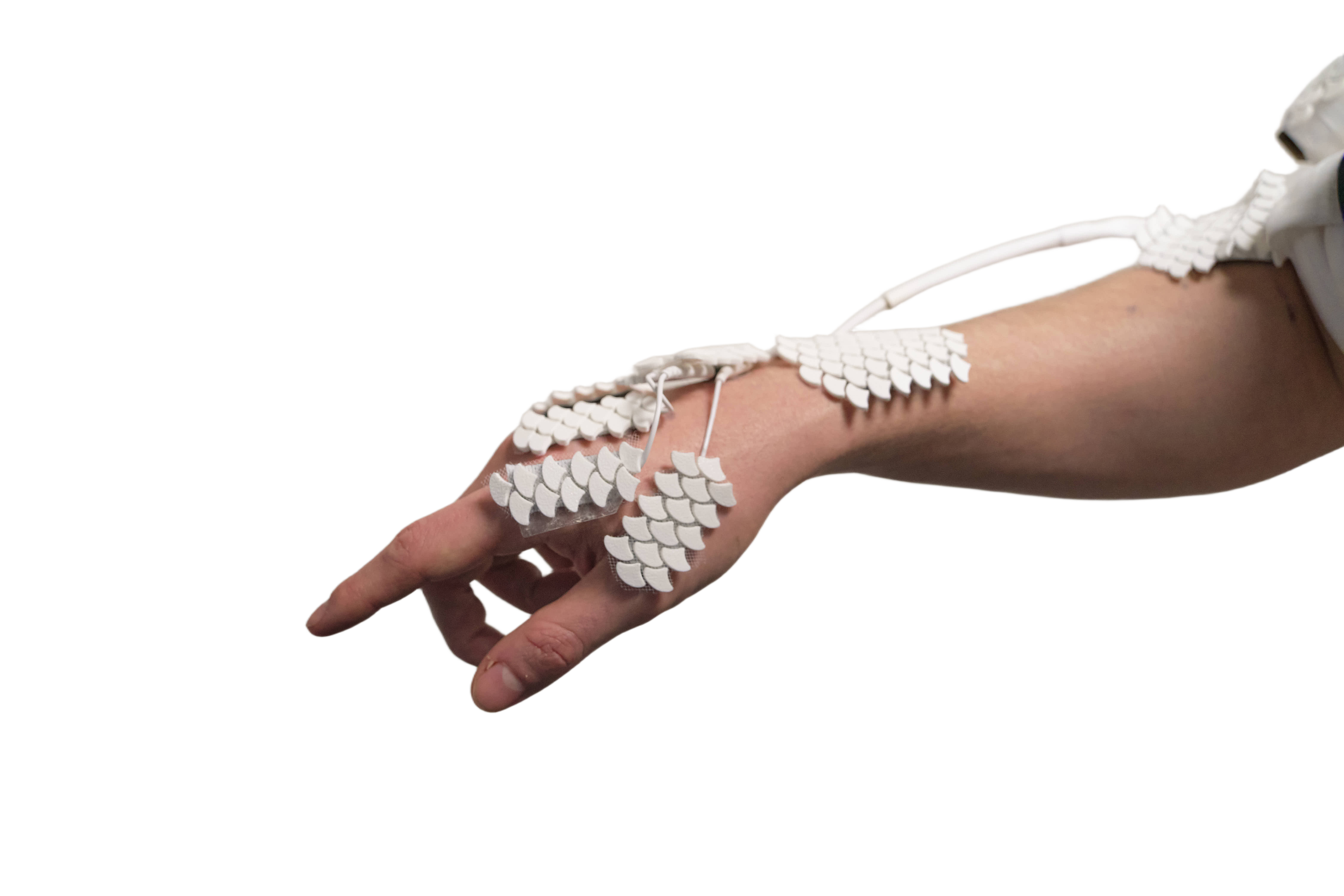
blocking palmar dexterity. The white scale-like patches visible on the
wearable are covering the electrodes placed.
I also ran calibration to find appropiate amplitude, frequency, and pulse-width
ranges per channel before we let the AI take over.
Human Operator is a prototype. It is not a medical device or a consumer product.
EMS can be dangerous if misused and requires calibration, caution, and informed consent.
Virality
20M+ Views
Funny enough, the project did go viral across Twitter/X, Instagram, Reddit, Youtube, 小红书 (RedNote) and etc.,
accumulating ~20
million views (if not more) across all sites.
Very interesting discussions were sparked about autonomy, AI, and the future of human computer interaction.
Some of the more viral posts (excluding quoted reposts and death threats lol) can be seen
here: